New report positions digestate at the heart of Europe’s fertiliser resilience and circular economy ambitions
20.05.2026Brussels, 20 May 2026 — As the European Commission unveiled yesterday its Fertiliser Action Plan, aimed at scaling up the supply of fertilisers, particularly bio-based alternatives, a new report published by the European Biogas Association (EBA) highlights digestate as a readily available circular solution capable of strengthening nutrient security, supporting farmers and improving soil health across Europe.
The report estimates that the environmental and nutrient value of digestate exceeds €1 billion per year. By 2050, Europe’s biogas sector could generate around 177 million tonnes of fertilisers from nutrient-rich waste streams, with nutrient potential projected to reach 9.7 million tonnes of nitrogen, 1.7 million tonnes of phosphorus and 0.8 million tonnes of potassium.
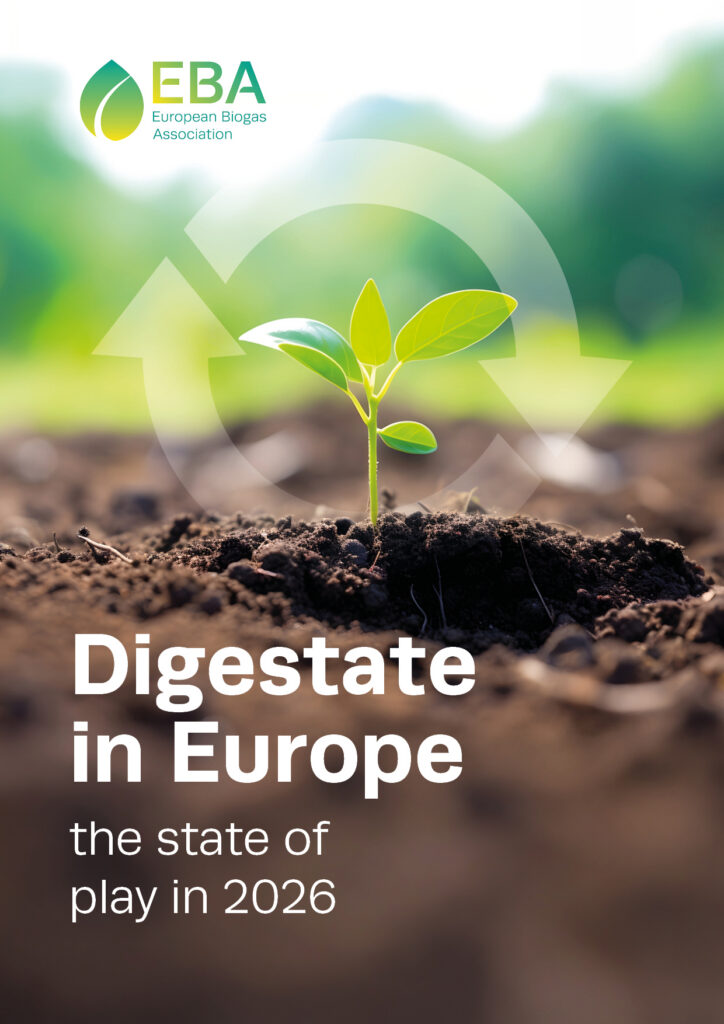
The report, Digestate in Europe: State of Play in 2026, provides new data on the scale, nutrient potential and economic value of digestate, the nutrient-rich co-product of anaerobic digestion (AD), the main technology used for the production of biogases today. The findings directly support several priorities identified in the Commission’s Fertiliser Action Plan, including nutrient circularity, domestic fertiliser production and development of bio-based alternatives.
“Digestate is becoming a strategic resource for Europe’s fertiliser resilience and circular economy objectives,” said Lucile Sever, Senior Policy Advisor at the EBA. “The Commission’s Fertiliser Action Plan sends an important signal by recognising the role digestate can play in reducing fossil fertiliser dependency while supporting European farmers and renewable energy production.”
According to the report, anaerobic digestion plants in Europe produced an estimated 25 million tonnes of digestate dry matter in 2024, mainly from agricultural feedstocks, with manure accounting for around 60% of input materials. Such production volumes could technically replace more than 16% of mineral nitrogen fertilisers used in European agriculture, alongside up to 30% of phosphorus and 10% of potassium demand.
Economically, effective digestate management can be a game changer for the viability of biogas plants. While logistics and storage represent a significant share of operating costs, particularly for larger or more centralised plants, local digestate use can help farmers reduce mineral fertiliser purchases and improve nutrient management efficiency.
Despite its proven environmental and economic benefits, stronger recognition and valorisation of digestate in EU legislation has long been a key priority for the biogas sector. In this context, the Commission’s Fertiliser Action Plan sends a strong positive signal for the sector, particularly through measures aimed at building a more integrated, circular and resilient European fertiliser market.
Alongside near-term actions such as extending RENURE criteria to digestate, facilitating rules governing the anaerobic digestion of animal by-products, mobilising CAP eco-schemes and facilitating investment support through Cohesion Funds, the plan also includes longer-term proposals to strengthen the market uptake of bio-based fertilisers across Europe.
“Creating stable market conditions and a coherent EU framework for bio-based fertilisers is essential to unlock investment and scale up nutrient recovery solutions across Europe,” added Lucile Sever. “The Fertiliser Action Plan is an important step towards recognising digestate as a strategic component of Europe’s long-term agricultural and industrial resilience.”
ENDS
Note for editors
About the report
Digestate in Europe: State of Play in 2026 provides an overview of digestate production, nutrient potential, economic value and regulatory barriers across Europe. The report assesses the role of digestate as a bio-based fertiliser and soil improver within Europe’s circular economy and agricultural transition.
About digestate
Digestate is the nutrient-rich co-product resulting from the anaerobic digestion of organic materials such as manure, agricultural residues, biowaste and wastewater sludge. It contains valuable nutrients including nitrogen, phosphorus and potassium, as well as organic matter that contributes to soil health and fertility. Digestate can be applied directly to land or upgraded into bio-based fertilising products.
About biogas and biomethane (biogases)
Biogas is produced from the decomposition of organic materials in the absence of oxygen. Through anaerobic digestion, organic matter breaks down and releases a blend of gases primarily composed of methane and carbon dioxide. Biomethane, the upgraded form of biogas, is a renewable alternative to natural gas that can be used across the energy, transport, and industrial sectors.
Contact: Charlotte Otten, EBA Senior Communications Officer – otten@europeanbiogas.eu