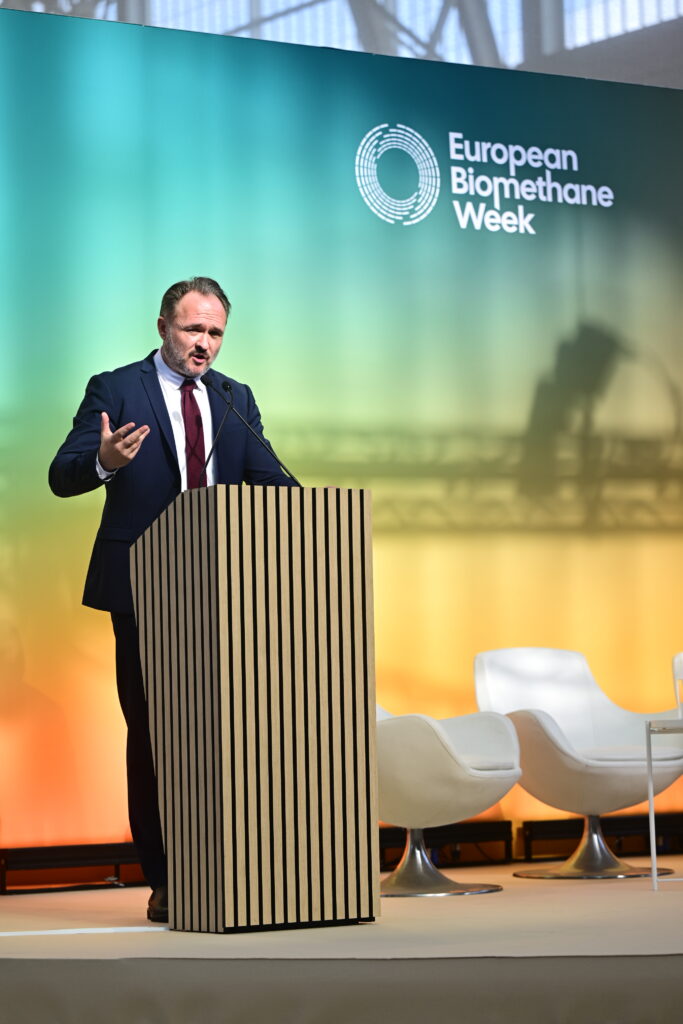
Commissioner for Energy Dan Jørgensen at European Biomethane Week 2026: Biomethane is a strategic asset for Europe’s energy security
14.10.2026Brussels, 14/10/2026 – EU Commissioner for Energy and Housing Dan Jørgensen put energy security and independence at the heart of Europe’s energy transition, highlighting biomethane as a strategic European asset that can strengthen security while supporting climate action. Speaking at the European Biomethane Week 2026 plenary conference in Brussels, the Commissioner stressed the continued need for renewable molecules such as biogas and biomethane in the energy mix.
“There is nothing more relevant than security. Yes, we need to look at prices and at flexibility, but independence needs to be the priority. Second thing is that climate change is here, and we know we need to act fast and do way more. Renewables play a big part to transition away from polluting electrons, but we will still need molecules and biogas biomethane is a part of those solutions.” EU Energy Commissioner Dan Jørgensen.
Biomethane production capacity in Europe has now surpassed 8 bcm, supported by €36 billion in announced investments, while biogas and biomethane together supplied approximately 22 bcm of gaseous energy in 2024, equivalent to around 7% of European gas demand. Europe is home to more than 20,000 biogas plants and nearly 1,700 biomethane upgrading facilities.
Yet, as stressed by Piero Gattoni, President of the European Biogas Association, in his opening statement, the sector “needs a regulatory framework that turns biomethane potential into investment, production and industrial demand. First, we need sustainability rules that are robust, proportionate and workable. Second, we must strengthen Europe’s circular bioeconomy. Third, biomethane must be fully recognised in Europe’s energy security and industrial strategies. Fourth, we must create the market conditions to unlock industrial demand. Finally, technological neutrality must guide the decarbonisation of heavy-duty transport and shipping. We are not asking for special privileges. We are asking for a regulatory framework that enables European biomethane to deliver its full potential. Together, we can build an energy system that is cleaner, more secure, more competitive and genuinely made in Europe.”
Today, the sector’s growth remains well below its available potential. A recent technical assessment indicates that Europe could produce 35 bcm of biomethane annually by 2030, making it one of the most immediate and scalable domestic solutions available to reduce dependence on imported fossil gas while supporting the continent’s climate and industrial objectives. The challenge is now the speed of deployment. Faster permitting procedures, stronger demand signals, a stable investment framework and a more integrated European market will be essential to unlock this potential.
Reflecting on this, Harmen Dekker, CEO of the European Biogas Association, stressed that “there are two main issues stopping the sector from growing at the speed it is capable to deliver. Firstly, lack of binding targets: some may conclude that targets do not work. But targets fail when technology is not ready, when investment flows largely outside Europe, when national and rural benefits are limited, or when they create new dependencies. Secondly, lack of full recognition of all the benefits and more specifically the organic fertilisers our sector provides. Around 98% of digestate already returns to agricultural soils, recycling valuable nutrients and organic matter. The challenge is not finding a use for it, but ensuring that its value is recognised. Today, digestate often has little to no market value, limiting investment in nutrient recovery and processing. As biogas production scales up, clear and appropriate end-of-waste criteria will be essential to develop markets for high-quality digestate products, strengthen Europe’s fertiliser sovereignty and reduce dependence on mineral fertilisers.”
The case for accelerated biomethane deployment is also being driven by rising industrial demand. During European Biomethane Week, Common Futures and Guidehouse launched the report Biomethane for a Climate-Neutral Industry, which highlights biomethane’s potential to provide a scalable, renewable solution for hard-to-abate sectors while supporting Europe’s transition towards a climate-neutral and competitive industrial base.
The study concludes that industrial demand for biomethane could grow from around 10 bcm by 2030 to 30 bcm by 2040, reaching approximately 35 bcm by 2050, nearly half of current European industrial natural gas consumption. It identifies strong potential across industrial processes including steel, chemicals, paper, ceramics and industrial heat production, where biomethane can provide both renewable energy and carbon-rich feedstock. The report further highlights that biomethane can support sectors where electrification may be challenging or costly, while also offering the possibility of negative emissions when combined with carbon capture and storage.
Held under the theme “Made in Europe: Biomethane at the Core of EU Energy Independence”, this year’s European Biomethane Week is expected to gather nearly 1,000 policymakers, industry leaders, investors, researchers and other stakeholders, alongside over 55 speakers and 50 partners, sponsors, exhibitors and media partners, to discuss the next phase of Europe’s renewable gas transition. The programme features high-level policy discussions, networking events, the EBA Awards, the European Renewable Gas Training Centre Masterclass and a dedicated workshop for policymakers and industry leaders that will be held tomorrow.
Additional speaker highlights
Full statement Commissioner for Energy and Housing
Paolo Frankl, Head of the Renewable Energy Division at the IEA: “Energy security and the energy transition need to be aligned. Direct electrification and energy efficiency are essential to transitioning away from fossil fuels, but we will need a lot of sustainable molecules both for energy security and decarbonization and biogas and biomethane are a reality now. At global level, more countries are moving beyond viewing biogases as a waste management solution and are integrating them into their energy systems strategy, with growing support for biomethane.”
Andris Piebalgs Professor & Chairman at European University Institute (EUI) & Board of the International Methane Emissions Observatory (Former EU Commissioner for Energy): “Energy security is an absolute priority today. In the past, it was largely a natural consequence of other policies. That is no longer the case.” (…) “The biogas sector needs to be more strategic, especially in three areas: infrastructure design, Europaisation (fully integrated European market) and demand-side: interest should not be only on the value of carbon. Demand should be stimulated.”
Josep Oriol Bellot, Senior Sector Engineer at EIB. Innovation and Competitiveness Department, Bioeconomy Division. European Investment Bank (EIB). “The EIB is implementing around 13% of REPowerEU investments and delivered €7.7 billion for bioeconomy projects last year, making it one of the main financiers of biogas. By contributing to climate and environmental objectives, including reducing direct GHG emissions from agricultural activities, improving groundwater quality, supporting the circular economy and rural population stability, and replacing natural gas and synthetic fertilisers, biogas and biomethane qualify for a 100% Climate Finance contribution.”
Dr. Stefan Rauh, Managing Director at Fachverband Biogas e.V: “Germany is seen as a leader of the biogas and biomethane markets. Biogas has gained its share on energy independency. We currently produce 8 bcm of biogas and biomethane in Germany and things are moving in the right direction because many Members of Parliament understood that biogas is important for multiple sectors. We hope that we will have a well-developed green gas quota system in 2028 that will enable the sector to move forward.”
Giulio Volpi, Policy Coordinator at DG CLIMA, European Commission: “As part of the review of post-2030 climate and energy goals, the European Commission is considering an EU-wide carbon removal target, including permanent removals, to be divided among Member States. The Commission is also set to establish a Carbon Removals and Carbon Farming registry to support credible market tracking and investment.”
Norbert Lins, MEP: “We need voluntary incentives to make nutrient management and renewable fertilisers attractive to farmers. These solutions must deliver tangible economic value while helping farmers improve resource efficiency.”
Contact
Angela Sainz Arnau, EBA Communications Director sainz@europeanbiogas.eu + 32 483 07 10 46
About the European Biomethane Week
The European Biomethane Week is Europe’s flagship event dedicated to biogas and biomethane. Organised by the European Biogas Association (EBA), it brings together producers, users, policymakers, investors, researchers and technology providers from across the renewable gas value chain. The 2026 edition takes place in Brussels from 12 to 16 October under the theme “Made in Europe: Biomethane at the Core of EU Energy Independence.” The programme includes high-level policy discussions, networking events, the EBA Awards, the European Renewable Gas Training Centre Masterclass and a dedicated workshop for policymakers and industry leaders.
About the European Biogas Association (EBA)
EBA fully believes in the future potential of renewable gas in Europe. Founded in 2009, the association is committed to the deployment of sustainable biogas and biomethane production and use throughout the continent. EBA counts today on a well-established network that represents over 8,000 stakeholders across Europe, including national associations, companies and research organisations covering the whole biogas and biomethane value chain.
About biogas and biomethane
Biogas is produced from the decomposition of organic materials. These residues are placed in a biogas digester in the absence of oxygen. With the help of a range of bacteria, organic matter breaks down, releasing a blend of gases: 45 – 85 vol% methane (CH4) and 25 – 50 vol% carbon dioxide (CO2). The output is a renewable gas which can be used for multiple applications.
Biomethane – purified biogas – is a renewable alternative to natural gas. Its multiple applications include heat and power supply for our buildings and industries, and renewable fuel production for the transport sector.
Produced from organic residues and sustainable biomass, biomethane delivers benefits well beyond renewable energy production. It contributes to industrial decarbonization and waste management, strengthens sustainable agriculture and rural economies, and generates valuable co-products such as organic fertilisers and biogenic CO₂, supporting Europe’s broader ambitions for resource efficiency, sustainability and strategic autonomy.