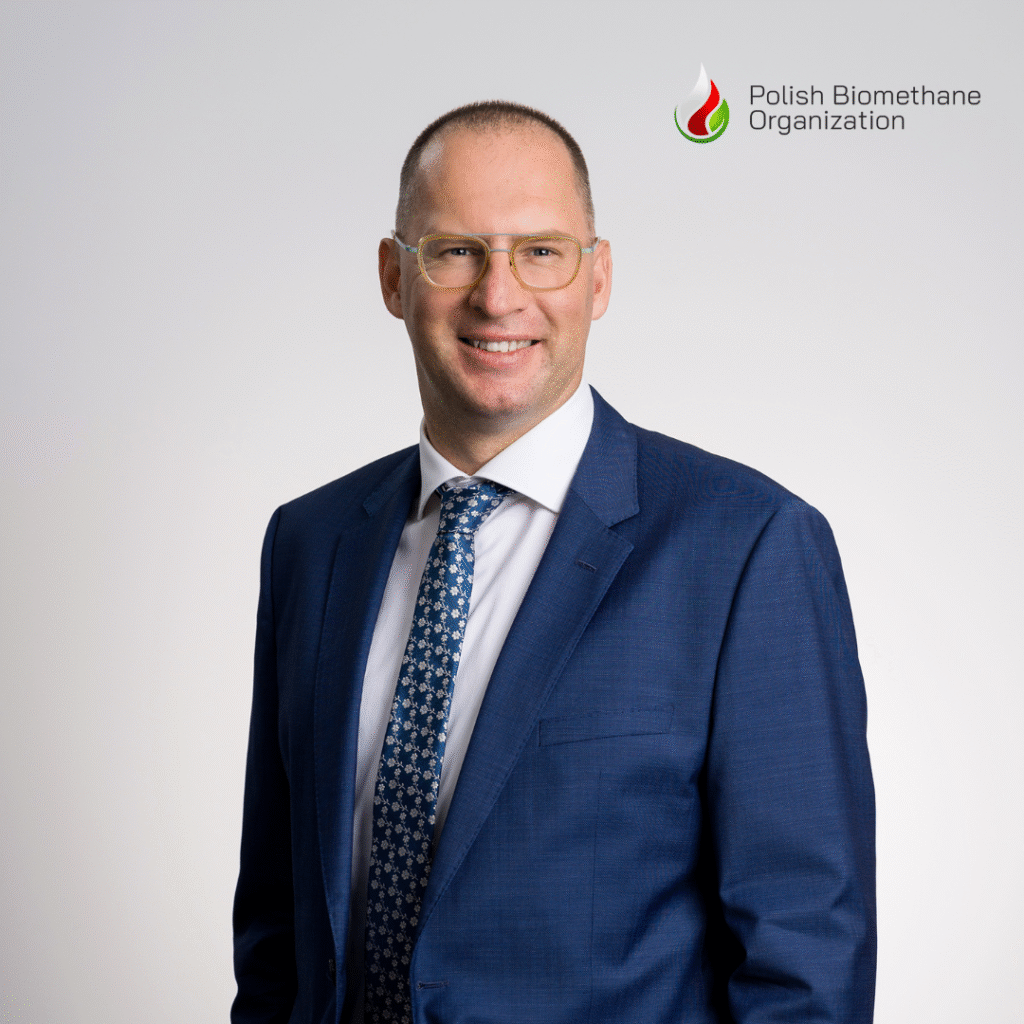
Conversation with Michal Tarka, Polish Biomethane Organization
27.11.2025We have had the chance to speak with Michal Tarka from the Polish Biomethane Organization, and talk about the first Biomethane Plant connected to the gas grid!
Could you briefly introduce yourself and the mission of the Polish Biomethane Organization?
My name is Michał Tarka and I am a renewable energy lawyer and manager in Poland. For more than 15 years I have been advising on strategic energy and fuel projects in Poland and the European Union, with a particular focus on biogas and biomethane. Today, I serve as the Founder, General Director and Management Board Member of the Polish Biomethane Organization. The mission of the Polish Biomethane Organization is very clear: to build a strong, competitive and sustainable biomethane sector in Poland. We bring together companies, investors, experts and local governments to accelerate the development of biomethane as a strategic part of the energy transition. Our role is to represent the sector in dialogue with policymakers, promote best practices, and ensure that Poland can fully unlock its enormous biomethane potential – estimated at 9 billion cubic metres annually. We believe that biomethane can become a pillar of Poland’s energy independence, rural development and climate neutrality. Our task is to make sure that the right regulatory, financial and technical conditions are in place to make this vision a reality. We do this not only through advocacy, but also by building awareness and cooperation among stakeholders.
Launch of Poland’s First Biomethane Plant Connected to the Gas Grid. Can you tell us about the significance of this milestone for Poland’s energy sector?
This first connection is more than a symbolic achievement in my opinion – it marks the beginning of a new chapter for Poland, where biomethane can become a pillar of a low-carbon, secure, and locally rooted energy system. We have to remember that the resource, feedstock base in Poland is substantial. With 14.7 million hectares of agricultural land (around 45% of the country) and 9.2 million hectares of forests (around 30%), Poland commands significant renewable feedstocks. Agriculture alone provides more than 3.7 million tonnes of residues annually – slurry, straw and crop by-products – all suitable for biogas and biomethane production. This is why the direction of developing renewable energy from biomass is particularly attractive in Poland: we are a country with one of the largest agricultural sectors in Europe, strong animal production traditions, and last but not least, with a highly developed gas transmission and distribution network. Poland’s reliance on imported natural gas has long been a strategic vulnerability. Biomethane, produced domestically from sustainable agricultural residues, manure and waste, directly addresses this challenge by reducing dependency and strengthening resilience against geopolitical shakes. Just as importantly, it is the only renewable gas that can substitute fossil natural gas one-to-one in existing infrastructure. Injecting the first cubic metres of biomethane into the grid demonstrates that Poland’s well-developed gas network can be progressively decarbonised without major technological barriers. The significance of this milestone can be described on several levels. First and foremost, it strengthens energy security and independence, ensuring that more of Poland’s gas demand can be met from local, renewable sources. Secondly, it brings tangible benefits for agriculture and rural development: biomethane plants offer new business models for farmers and municipalities, turning residues into valuable energy and fertilisers, creating jobs and stimulating regional economies, while contributing to a circular bioeconomy. Finally, it is a powerful regulatory and investment signal. The commissioning of this first plant demonstrates to policymakers and investors alike that the sector is ready to scale up rapidly – provided that the right support framework is put in place. This success opens the way for biomethane to become one of the cornerstones of Poland’s energy transition.
Could you describe the main features of the Suedzucker plant and how it operates: from feedstock to grid injection?
The plant, operated by Europe’s largest sugar refiner, produces biogas from feedstock that is already available on site – sugar beet pulp generated during sugar production. This raw biogas is processed in four fermenters of 10,000 cubic metres each and two post-fermenters. It is then upgraded in a dedicated installation to biomethane, reaching the required quality for injection. A 9-kilometre pipeline, completed jointly by Südzucker Polska and Polska Spółka Gazownictwa (Polish Gas Company), connects the facility to the national distribution network. The new infrastructure, including advanced biogas upgrading technology, allows part of the green gas to be used by the Strzelin sugar factory itself, while the surplus is injected into the grid. What makes this project special is not only the technical scale, with 45 MW installed capacity, but also the model it represents: a large industrial player embedding renewable gas directly into its production process, while contributing to Poland’s energy independence and climate goals. Equally important, the plant closes the loop in agricultural production. The digestate left from the biogas production process is returned to fields as a valuable organic fertiliser, ensuring that in the production of sugar and the cultivation of beets nothing goes to waste.
How much biomethane will the plant produce annually, and what proportion will be used by the factory versus injected into the national grid?
The Strzelin facility has a capacity of 45 MW and can produce over 9,000 cubic metres of biogas per hour. This translates into an impressive biomethane output in Europe, making it a flagship project not only for Poland but for the whole regionIf we take into account utilisation, the balance between internal consumption and grid injection will vary throughout the year. During the sugar campaign – the most energy-intensive period in autumn – the factory’s own needs will dominate. Südzucker has already indicated that about 80% of the plant’s energy use will be covered by biogas, with only 20% complemented by natural gas. In this period, the share of biomethane injected into the grid will therefore be lower. Outside the campaign season, however, the factory’s energy demand decreases significantly. This means that a larger share of biomethane can be directed into the grid via the 9-kilometre connection, supporting Poland’s wider energy system with this stable, renewable gas source.
How does this project fit into Poland’s broader strategy for energy transition and decarbonisation?
Poland’s energy system is at a turning point. While we have successfully met many of the EU’s 2020 climate and energy targets, the 2030 objectives represent a much greater challenge – and the path towards deep decarbonisation by 2050, combined with a full phase-out of Russian fossil fuels, is even more demanding. Between 2025 and 2030 we expect to see a further reduction in coal use in power generation, the gradual decarbonisation of transport, heating, agriculture and industry, as well as stronger sector integration strategies. The Südzucker plant is a first practical step towards Poland meeting the ambitious national and European targets – 1.5 bcm of biomethane by 2030, nearly 3.9 bcm by 2040, and contributing to the EU-wide REPowerEU target of 35 bcm by 2030. It demonstrates that decarbonisation of the gas system is possible without costly overhauls, by using existing infrastructure and local feedstocks. In this sense for me Strzelin is a model project aligned with Poland’s long-term strategy: phasing out coal, reducing import dependency, and building a low-carbon, resilient energy system. For Poland, where security of supply and energy independence are just as important as climate neutrality, biomethane provides a unique double benefit: it strengthens resilience against geopolitical shocks while supporting the EU’s broader decarbonisation agenda. Projects like this show how local resources can be transformed into clean energy and how industry, farmers and local communities can become active players in the transition. This is exactly the type of solution that fits into Poland’s long-term energy and climate strategy – helping to meet 2030 goals, laying the foundations for 2050, and proving that decarbonisation can go hand in hand with economic development and stability.
What impact do you expect this plant to have on local communities, both in terms of energy supply and economic development?
I am sure that the impact of the Südzucker biomethane plant on the local community will be visible on several levels. First, it will directly strengthen energy security by producing renewable gas locally. Most of the biomethane will serve the factory itself, reducing reliance on fossil fuels, while the surplus injected into the grid increases the share of clean energy available in the region. Producing energy close to where it is consumed means a higher level of resilience, which is particularly important in today’s geopolitical context. Looking beyond this single project, Poland has set ambitious targets in its updated National Energy and Climate Plan: by 2030, and by 2040. To achieve these goals, we can expect around 80 similar plants to be developed by the end of this decade. This plant definitely encourages other investors to act. And in the event, with more and more plants to be opened, we would not only decarbonise part of our gas supply, but also help communities across the country to benefit from local energy production, new jobs, and more sustainable farming practices. Strzelin is a first step – but for me it is one with a multiplier effect, showing communities and investors alike that biomethane can be both an energy solution and a driver of local development.
With this first plant now operational, what are the next steps for scaling up biomethane production and grid integration in Poland?
With the first plant now connected to the grid, the next steps are clear for me : we need to move from a single flagship project to a full-scale rollout of biomethane across Poland. The technical potential is already there – estimates point to around 7–8 billion cubic metres annually, while the report of the Polish Biomethane Organization conducted on the basis of construction permits issued in local governments point to even 9 billion cubic metres annually – and the national targets set in the updated Energy and Climate Plan are ambitious but realistic (1.5 bcm of biomethane by 2030 and nearly 3.9 bcm by 2040). To achieve this, several elements must come together. First, a stable regulatory framework and dedicated support mechanisms are essential to give investors the certainty they need. This is hopefully already happening with the government setting up the Ministry of Energy and working on legal frames for tools such as biomethane auctions, operational support schemes, streamlined grid integration and accelerated permitting procedures. As the Polish Biomethane Organization, we are in ongoing dialogue with ministries, energy experts and regulators, stressing that the sector in Poland is ready to deliver on the national targets – provided an effective support system is put in place. Second, we must ensure that gas grid integration keeps pace with new projects, through investments in connections and regional distribution networks. Third, the sector should encourage cooperation between farmers, local governments and industry – this is the foundation for developing robust feedstock chains and social acceptance.
What message would you like to share with policymakers, investors, or other stakeholders about the future of biomethane in Poland and Europe?
My key message is that biomethane is no longer a distant vision – it is here, proven, and ready to scale. The launch of Poland’s first grid-connected plant shows that the sector is technically and economically feasible, and that it delivers multiple benefits at once: decarbonisation, energy security, rural development, and circularity. My appeal is clear:
To policymakers – create a stable, long-term framework that gives investors confidence and accelerates the deployment of biomethane. Regulatory certainty is the foundation for scaling up and further economic investment.
To investors – look to Poland. With one of the largest feedstock availability in Europe and the untapped biomethane potential – up to 9 bcm annually – and with projects like Strzelin already proving feasibility, the time to enter this market is now.
To local communities – see biomethane as an opportunity, not a threat. Modern plants are built to the highest environmental standards, with effective technologies that prevent odour emissions and protect the quality of life for residents. Biomethane brings cleaner energy, stronger local economies – without the nuisance often associated with older biogas facilities.
At the European level, biomethane will be crucial for achieving REPowerEU targets of 35 bcm by 2030. Poland has the full potential to be a significant contributor to this effort. What we need now is decisive action, effective support mechanisms, and strong cooperation across the value chain. This is definitelty the momentum. If we succeed, biomethane will become not only a fuel for the energy transition, but also a driver of resilience for our continent.