Europe adds 1 bcm of biomethane production, but acceleration of its own source of renewable gas can go much faster
01.07.2026Brussels, 01/07/2026 – The European Biogas Association (EBA) today unveils two major publications: the European Biomethane Map, developed in cooperation with Gas Infrastructure Europe (GIE), and the Biomethane Investment Outlook. Together, they show a sector that continues to grow rapidly and attract investment, while also highlighting the significant untapped potential for further acceleration across Europe.
Europe’s biomethane sector has crossed a new milestone, adding more than 1 billion cubic metre (bcm) of annual production capacity in just one year and surpassing 8 bcm for the first time. Yet despite growing investor confidence and rising political attention on energy security, the growth falls well behind its true acceleration potential. Installed biomethane production capacity reached 8.2 bcm per year by the end of Q2 2026, up 17% compared to 2025, according to the European Biomethane Map, released today by EBA and GIE.
“Biomethane is becoming a strategic pillar of Europe’s energy transition. By making full use of existing gas infrastructure, we can connect production with demand across borders, strengthen Europe’s energy security and unlock the full potential of renewable gases,” said Lucie Boost, Secretary General of Gas Infrastructure Europe.
Investor appetite also remains strong, with investment commitments reaching €36 billion, a significant increase from last year’s reported investments (€28 billion), according to the Biomethane Investment Outlook. This growing investment confidence underlines the sector’s significant acceleration potential, provided that the right regulatory conditions are put in place. If fully realised, these investments are expected to deliver 9 bcm/year of additional biomethane production capacity by 2030, strengthening Europe’s domestic energy supply and contributing to the EU’s decarbonisation objectives.
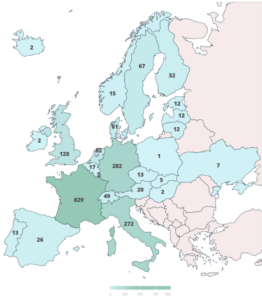
The Biomethane Map shows that the number of plants in Europe increased from 1,678 to 1,975 between the 2025 and 2026 data collection periods. During that time, 327 new plants entered operation. As some plants also closed during the same period, the net increase is lower than the total number of new plants commissioned. Nevertheless, the figures point to continued momentum across the sector.
However, growth remains uneven across the bloc. While national production is expected to rise significantly by 2030 in line with Member States’ targets, just five countries currently account for 95% of European biomethane production. The concentration of production highlights both the success of leading markets and the untapped potential in Europe. According to a 2026 Guidehouse study, the EU-27’s potential stands at 31–32 bcm for 2030 and is projected to reach 163–184 bcm by 2050.
The average biomethane plant size in Europe is 472 Nm³/h, though there is wide variation across the continent. France, despite its leadership in plant numbers, maintains smaller installations averaging 212 Nm³/h. In contrast, Italy (667 Nm³/h) and Germany (607 Nm³/h) operate larger facilities, contributing more to total capacity. Denmark (1528 Nm³/h) also features fewer but significantly larger plants.
The findings underscore the need for clear and coherent policy frameworks to accelerate deployment across all Member States. Industry stakeholders are calling for regulatory certainty and dedicated strategies for biomethane to help translate investment ambitions into operational projects.
As Europe continues to address energy security challenges, geopolitical uncertainty and dependence on imported fossil fuels, biomethane is increasingly recognised as a strategic renewable energy source. Produced domestically and integrated into existing energy systems, it can contribute to both energy security and climate objectives.
With sustainable feedstocks available across Europe, existing gas infrastructure ready for integration, and valuable co-products supporting circular economy objectives, the conditions are in place for further biomethane deployment. The sector’s continued growth reflects its increasing role in Europe’s energy transition.
“Biomethane is increasingly viewed as a key pillar of Europe’s efforts to enhance energy security and accelerate defossilisation. However, uncertainty and regulatory complexity continue to hold the sector back from reaching its full potential. One of the simplest measures we can take is to allow existing plants to produce at higher capacity (currently averaging 70%). This, alongside reducing complexity in access to feedstock, facilitating grid connections and accelerating permitting, would enable the sector to scale much more rapidly,” explained Harmen Dekker, EBA’s CEO.
Key figures
-
- 8.2 bcm/year biomethane capacity in Europe (end of Q2 2026)
- +1 bcm added in one year (+17% vs 2025)
- 1,975 plants in operation (up from 1,678)
- 327 new plants commissioned
- Average plant size: 472 Nm³/h
- €36 billion allocated to investment
Number of biomethane plants per country across Europe
ENDS
Note for editors
About the Biomethane Map: The European Biomethane Map is an annual publication by the European Biogas Association (EBA) and Gas Infrastructure Europe (GIE) tracking the rollout of biomethane plants in Europe. A printable version of the map is also available. A detailed online map and report with additional information are available for EBA members only. EBA and GIE would like to thank all contributors and members who provided the data that made this publication possible.
About the Biomethane Investments Outlook: EBA monitors biomethane investments yearly to forecast the growth of the sector and better identify market trends, drivers, and gaps. The figures presented are based on replies from investors and project developers within Europe.
About biogas and biomethane (biogases): Biogas is produced from the decomposition of organic materials. These residues are placed in a biogas digester in the absence of oxygen. With the help of a range of bacteria, organic matter breaks down, releasing a blend of gases: 45 – 85 vol% methane (CH4) and 25 – 50 vol% carbon dioxide (CO2). The output is a renewable gas which can be used for multiple applications. Biomethane – purified biogas – is a renewable alternative to natural gas. Its multiple applications include heat and power supply for our buildings and industries, and renewable fuel production for the transport sector.
Impact of biogases beyond energy: Beyond energy, biogas plants operate as modern biorefineries, transforming waste into high-value products that directly strengthen the EU bioeconomy. Biomethane can be converted into hydrogen, methanol, or syngas for bio-based chemicals and plastics, reducing reliance on imported fossil fuels. Digestate, as a nutrient-rich co-product, can be processed into bio-fertilisers, improving soil health, supporting food security, and replacing fossil-based alternatives. Likewise, biogenic CO2 can be captured for industrial uses, including e-fuels, greenhouses, food and beverage production. By generating multiple circular products alongside renewable energy, biogas systems create a low-carbon, resource-efficient value chain that boosts industrial competitiveness and advances Europe’s circular bioeconomy.
Contact: Charlotte Otten, EBA Senior Communications Officer – otten@europeanbiogas.eu